Saturday, June 30, 2007

Five-lined Skink

The Five-lined Skink (Eumeces fasciatus) is one of the most common lizards in the Eastern United States, so we saw them when we lived in Alabama and enjoy seeing them here in Central Virginia.
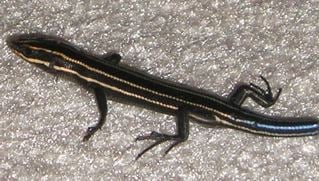
You can see how they got their name with this photo that shows the light-colored lines. They also have a bright blue tail which is what usually attracts our attention as they dart about our deck and grounds. Their size is from 5 to 8 inches long.

Our cat, Squeek, enjoys seeing them squeeze under the screen door on the screened porch. She sits there on the rug watching and now and then one will tease her. This one apparently wandered by and into the house. She's a great alert kitty to things that don't "belong" in the house. She was meowing and following behind this one that we found on the living room carpet.

They are poisonous to household pets and having been a feral kitty, she knows better than to think of it as a snack.

Although these skinks are smooth like a salamander, they are is lizards. Lizards are reptiles which have claws and ear openings, while salamanders are amphibians which lack both claws and ear openings.

The females retain the striped and blue tailed pattern for life, but the adult male's coloring becomes brown or olive.

During mating season in Spring, the head and jaws of the male turn orange-red which helps them to attract a female.

Their nest is created in rotting logs, loose soil, or leaf litter where 4-15 eggs are laid. We had one nest under a garden statue of a Mallard Duck.

The female skink guards the nest until the young are born. After only 1-2 days the newborn skinks are left to their own instincts.

To attract skinks or other reptiles to your garden, provide lots of shelter in the form of dense vegetation, brush and rock piles, and fallen logs. Let leaf litter accumulate and place a rock or log where it receives morning sun as an invitation for basking reptiles.

They will reward your efforts by consuming roaches, grasshoppers, beetle larvae, spiders, crickets, flies, grubs, crustaceans, worms and even small mice, a diet more varied than that of some other skinks.

They are extremely important to humans as natural pest controls and play an important role in the survival of many larger lizards, birds, mammals, and snakes as they are a food source for these predatory animals.

One of their defense mechanisms is a tail that easily breaks. If confronted or grasped, the skink's tail breaks away and continues to wiggle wildly keeping the attention of the attacker on the tail, while allowing the skink to escape. The tail does grow back, but not to the original length, and it is left more defenseless until then, so viewing them from a distance is best since skinks shouldn't be handled.

Although considered terrestrial (ground dwelling), the Five-lined Skink will climb a decayed snag in its forest home where it knows insects can be found. Although secretive and wary of anything that moves, skinks occasionally bask on rocks or logs in the sun, but take shelter under logs, rocks and leaf litter in the heat of the afternoon.

Its most comfortable temperature range is 78-85 degrees and it is most active during the day. In areas where Winter brings cold, they hibernate in rotting logs, under large rocks, or underground.

Copyright Info
© 1999 Donna L. Watkins

All photographs are the property of the editor, Donna L. Watkins. This article may not be used on any website. If you'd like to share this article, you can forward the link to it.

Quick Links to The Herbs Place, Our Sponsor

Current Specials
Online Catalog
Products A-Z
Home Business
Women
Men
Children
Pet Health Topics
Essential Oils

Natria Beauty Products
Non-toxic Laundry and Cleaning

Complimentary Email Newsletters


The Herbs Place offers several newsletters with topics such as natural health, essential oils, pets, nature, and frugal living. More about newsletters.

0 Comments:

Post a Comment

<< Home